Free tool · Based on chapters 3 and 4 of the book
Essential oil dilution calculator and chart
The rule: 1 ml is 20 drops. Drops of essential oil = milliliters of carrier oil × dilution × 20. A 10 ml (⅓ fl oz) roll-on at 2% takes 4 drops; a 30 ml (1 fl oz) bottle, 12.
Updated
Dilution 2%
The standard balance for everyday use on healthy, large areas of skin.
A guide only, rounded down. If you blend several oils, the total number of drops is for all of them together. It does not replace the advice of a doctor who knows aromatherapy.
How to dilute essential oils step by step
- Choose the dilution. It depends on the person and the use: 2% for an adult in general use, 1% during pregnancy, for sensitive skin, or for older adults, and 3–5% only on small areas and occasionally.
- Choose the carrier oil. Fractionated coconut oil is the most versatile starting point; jojoba and sweet almond oil are good alternatives.
- Calculate the drops. Milliliters of carrier × dilution × 20. If you blend several oils, the total is for all of them together.
- Mix in dark glass and keep the bottle tightly closed, away from heat and light.
- Do a patch test. Apply the blend to a small area of skin and wait 24 hours before using it on a larger area.
Blend examples
| Who it's for | Carrier | Essential oil | Dilution |
|---|---|---|---|
| Adult, roll-on | 10 ml (⅓ fl oz) fractionated coconut oil | 4 drops of lavender | 2% |
| Adult, body | 30 ml (1 fl oz) sweet almond oil | 12 drops in total, shared between lavender and peppermint | 2% |
| Pregnancy | 30 ml (1 fl oz) sweet almond oil | 6 drops of lavender | 1% |
| Child 2 to 6 years | 30 ml (1 fl oz) fractionated coconut oil | 6 drops of lavender, kept away from the face | 1% |
Dilution chart: drops by volume
Using the standard of 20 drops per milliliter. If you blend several essential oils, the total in the chart is for all of them together.
| Dilution | 10 ml (⅓ fl oz, roll-on) | 30 ml (1 fl oz) | 50 ml (1.7 fl oz) | 100 ml |
|---|---|---|---|---|
| 0.5% | 1 | 3 | 5 | 10 |
| 1% | 2 | 6 | 10 | 20 |
| 2% | 4 | 12 | 20 | 40 |
| 3% | 6 | 18 | 30 | 60 |
| 5% | 10 | 30 | 50 | 100 |
Which dilution for which situation?
| Dilution | Situation | Why |
|---|---|---|
| 1% | Pregnancy · sensitive or reactive skin · older adults | Reduces exposure when the skin is more permeable or the metabolism slower. |
| 2% | Adults · general full-body use | The standard balance for everyday use on healthy, large areas of skin. |
| 3–5% | Localized areas · occasional use | Small areas; not for full-body massage or daily application. |
Pregnant or breastfeeding? Dilution is only one part of it: see the traffic-light guide to essential oils in pregnancy (in Spanish).
Dilution for babies and children: the chart by age
The no-go areas and the oils that are not used are in the guide to essential oils for babies and children (in Spanish).
| Age | Maximum dilution | Drops in 30 ml (1 fl oz) | Use criteria |
|---|---|---|---|
| 0–3 months | 0–0.1% | 0–1 | Exceptional use only. Hydrosols are better, with the pediatrician's approval. If oil is used, only very gentle diffusion in a large room; never on the skin. |
| 3–24 months | 0.25–0.5% | 1–3 | Body only: never the face, chest, or hands. Gentle oils (esters, alcohols). |
| 2–6 years | 1–2% | 6–12 | Gradual introduction. No peppermint, eucalyptus globulus, or camphor near the face. |
| 6–12 years | 1.5–3% | 9–18 | Almost like adults, with a conservative margin. |
| 12+ years | 2.5–5% | 15–30 | Standard adult range, with supervision. |
What to dilute in: carrier oils
| Carrier | Absorption | Skin type | Best for |
|---|---|---|---|
| Fractionated coconut oil | Fast, light, no residue | All types | Daily use, roll-ons, all-purpose blends |
| Jojoba | Very fast | Oily, combination, acne-prone | Facial formulas |
| Sweet almond oil | Medium, gentle | Normal, sensitive | Long massages, delicate skin |
| Rosehip | Medium to deep | Mature, with scars or dark spots | Skin renewal, stretch marks |
| Argan | Deep, rich | Dry, damaged barrier | Intensive care |
Citrus and sun: an extra limit
Cold-pressed citrus oils are phototoxic. On skin that will be exposed to the sun, IFRA sets a maximum: bergamot 0.4%, lime 0.7%, bitter orange 1.25%, lemon 2%, and grapefruit 4%. Above that, wait 12 to 18 hours before going out in the sun, or use the steam-distilled or “FCF” (bergapten-free) version.
What this guide leaves to the book
The calculator gives you the drops, but it doesn't know which oil you're going to use. That changes the result, and that's where the book comes in:
- “Hot” oils (chapter 9). They have their own limits below 2%. For cinnamon bark, it's 1 drop in 100 ml.
- Sensitization (chapter 8). Which oils cause it most and how to rotate them, because it also happens at a correct dilution.
- Older adults and medication (chapters 6 and 12). When it's best to stay at the low end of the range and what to watch for.
- Opened bottles (chapter 10). An oxidized oil can sensitize the skin even when you dilute it properly. That's where you'll find how long each family lasts.
- Complete dilution chart (Appendix B). All the situations together, to look up without opening the website.
To have on hand when you open the bottle: 184 pages, 15 chapters, and 7 quick-reference appendices. See the book on Amazon
Frequently asked questions about dilution
How do you dilute essential oils?
Choose the dilution based on the person and the use, measure the carrier oil, add the drops (milliliters × dilution × 20), mix in a dark glass bottle, and do a 24-hour patch test. For an adult in general use, the reference is 2%: 4 drops in 10 ml.
How many drops of essential oil are in one milliliter?
The industry standard is 20 drops per milliliter. With that figure: drops = milliliters × dilution (as a decimal) × 20. For example, 30 ml at 2% is 30 × 0.02 × 20 = 12 drops.
How many drops of essential oil go in 10 ml of carrier oil?
In a 10 ml roll-on: 2 drops at 1%, 4 at 2%, 6 at 3%, and 10 at 5%. For an adult in general use, 4 drops (2%).
What do you dilute essential oils in?
In a vegetable carrier oil. Fractionated coconut oil is the most versatile: it has no scent, doesn't stain, and doesn't clog pores. Jojoba resembles the skin's own sebum; sweet almond oil suits delicate skin and long massages; rosehip and argan bring their own skin care.
Can you dilute essential oils in water?
No. Oil and water don't mix: in a bath, the oil floats in tiny droplets that touch the skin undiluted, and hot water increases absorption. To disperse it in water you need a solubilizer; hydrosols are the water-based alternative.
How many drops of essential oil go in a diffuser?
Follow your diffuser's instructions, because every model has a different tank. What the book does set is the time: intermittent diffusion, 30 to 60 minutes on and an equal break, and no more than 30 minutes during pregnancy or around children and pets, always with ventilation.
If I blend several oils, how many drops of each do I use?
The total number of drops is for all of them together. In 30 ml at 2% you have 12 drops to share among all the oils, not 12 of each.
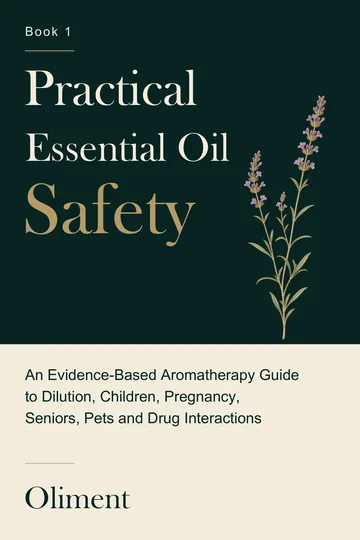
Where these figures come from
It's all in the book, with the why behind every rule.
Practical Essential Oil Safety devotes chapters 3 and 4 to dilution, and Appendix B brings all the charts together in one place.
As an Amazon Associate, we earn from qualifying purchases.