Safety guide · Based on the book
Essential oil safety: 7 rules and the reasons behind them
Dilute before applying to the skin (2% for an adult), patch test every new oil, avoid the sun after using expressed citrus oils, and change the rules for babies, pregnancy, pets or medications.
Updated
Before you go on: this guide is general and does not know your situation. Before using an oil, talk to a doctor familiar with aromatherapy, especially if you have a medical condition, take medication or are pregnant.
As an Amazon Associate we earn from qualifying purchases. The book links on this page are affiliate links.
Why something natural still needs rules
An essential oil is fifty to one hundred times more potent than the plant it comes from. It can pass through the skin, reach the brain through the sense of smell within seconds and interact with medications in ways no bottle warns you about.
That potency is what makes them interesting, and it is also why using them wrongly has consequences. Those consequences are easy to avoid, and you do not need to be a chemist: the risk lies in using the oil as if concentration did not matter.
The seven rules, one by one
Each rule comes with its reason, an example and the chapter of the book where you will find the details.
1. Dilute before applying to the skin
A neat drop concentrates its entire chemical load on a tiny area. Mixed with a carrier oil, that is, a vegetable oil without a strong aroma, it spreads over a larger surface. The effect remains and the risk of irritation goes down.
2% is the starting point for most adults. The math is: milliliters × percentage × 20 drops. In 30 ml at 2%, 30 × 0.02 × 20 = 12 drops. 3–5% is reserved for small areas and occasional use, never for a full-body massage.
In Chapter 3: the drops-by-volume table, how to choose a carrier for your skin and which dilution fits each situation. See the book on Amazon · Calculate my drops
2. Test every new oil
Sensitization is an immune response that turns an oil you used to tolerate into a permanent irritant. That is why it pays to test it first: dilute to 2%, apply a little to the inside of your forearm and do not wash or cover the area. Check after 24 hours and wait another 24, because some reactions show up late.
If there is no redness, itching or swelling after 48 hours, your skin tolerates it for now. That does not guarantee it always will: using the same oil every day for months can change the result.
In Chapter 8: which oils are the strongest sensitizers, how to rotate them and the early signs that are easy to miss. See the book on Amazon
3. Be careful with the sun after a citrus oil
Cold-pressed citrus oils contain furanocoumarins, compounds that are inert in the dark but release energy onto the skin under UVA radiation. The result can range from intense redness to blisters and dark patches that last for months, even if the oil was applied hours earlier.
Wait 12 to 18 hours before going out in the sun. The strictest case is expressed bergamot: 0.4% maximum according to IFRA, about 2 drops in 30 ml. If you are going to be in the sun, steam-distilled oils do not have that limit.
In Chapter 7 and Appendix C: the limit for each citrus oil, other phototoxic plants that do not smell like lemon and what to look for on the label. See the book on Amazon
4. Babies and children need different doses
A baby is not a small adult. A baby's liver clears these compounds more slowly, so they can build up. Between 3 and 24 months, the maximum dilution drops to 0.25–0.5%. For children under 2, hydrosols such as lavender or Roman chamomile are often used instead, but check with a pediatrician familiar with aromatherapy first.
Some rules are absolute. Wintergreen is prohibited for children, and peppermint is never used near the face of children under 6: menthol can trigger a reflex that slows breathing, and a baby cannot yet compensate for it.
In Chapter 4: the table by age, the areas to avoid and the summary of prohibitions. See the book on Amazon · Babies and children guide (in Spanish)
5. During pregnancy, use less and choose with more care
Essential oil molecules are small, dissolve easily in fat and cross the placenta. The fetus receives what you receive, with a liver that is not yet ready to clear it. That is why the reference dilution is 1% for all nine months and diffusion does not go beyond 30 minutes at a time.
Sage (Salvia officinalis), rosemary ct. camphor and juniper berry are ruled out for the entire pregnancy. If an oil is not in the table and there is no clear data, the answer is not to use it. Lavender and mandarin have a gentle profile, always with the approval of an OB-GYN or midwife familiar with aromatherapy.
In Chapter 5: the traffic-light system by trimester and for breastfeeding, with the reason for each restriction. See the book on Amazon · Pregnancy guide (in Spanish)
6. What you diffuse, your pet breathes too
A cat's liver lacks glucuronosyltransferase, an enzyme that clears many of these compounds. What smells pleasant to you builds up in your cat. Avoid tea tree, peppermint, clove, cinnamon, oregano and eucalyptus around cats. With birds, no oil at all in the same space.
If you have a cat and want to diffuse, keep it short, ventilate the room and leave the door open so your cat can leave.
In Chapter 14: the table by species for dogs, cats and birds, and why pennyroyal does not work as a repellent. See the book on Amazon · Cats and dogs guide (in Spanish)
7. If you take medication, ask one question
The liver processes most medications with a group of enzymes called CYP450. That is why many package inserts warn against grapefruit juice, and some essential oil compounds act on those same enzymes. Eugenol from clove, for example, inhibits the enzyme that metabolizes warfarin, which can raise your INR without any change to your dose.
Clinical evidence is still limited, but the mechanism is documented. If you take long-term medication, bring the name of the oil and your medication list to your doctor or pharmacist, ideally one familiar with aromatherapy. The risk is considerably lower with diffusion than with repeated use on the skin.
In Chapter 12: what to watch for by type of medication and the signs that call for that conversation. See the book on Amazon
If something goes wrong: the first step
Keep a carrier oil within reach, outside the drawer where you store your essential oils. In almost every one of these cases it is the first thing you will need, and water alone does not work because essential oils do not mix with it.
- On the skin: apply plenty of carrier oil, then wash with warm water and mild soap. Seek medical attention if blisters appear or if the burning does not ease within 15–20 minutes.
- In the eyes: put carrier oil on the closed eyelid and rinse with cold water or whole milk, without rubbing. If it does not improve within minutes, go to the emergency room.
- Accidental ingestion: do not induce vomiting. Call Poison Control (1-800-222-1222, poisonhelp.org). If the person is unconscious or has trouble breathing, call 911.
- If inhaled: get to fresh air and use rescue medication if you have it. Call 911 if it does not improve within 5–10 minutes, if there is wheezing, if it is hard to speak or if the lips turn bluish.
These steps summarize Chapter 15 of the book.
What this guide leaves for the book
Seven rules cover the basics. These risks depend on the specific oil and need tables to be applied correctly:
- “Hot” oils (Chapter 9). The skin limit varies widely from one oil to another: for cinnamon bark it is 1 drop in 100 ml.
- Oxidation (Chapter 10). How long each family of oils lasts once opened and how to store them.
- Chemotypes (Chapter 11). Two bottles of rosemary or thyme can have different rules. The chapter explains how to tell them apart on the label.
- Older adults (Chapter 6) and asthma or COPD (Chapter 13). The dilutions, the right oils and when to stop.
- Seven quick-reference appendices. Oils by risk level, the full dilution table, warning signs and sources.
Sources
- Tisserand, R. and Young, R. (2014). Essential Oil Safety: A Guide for Health Care Professionals, 2nd ed. Churchill Livingstone / Elsevier.
- IFPA, International Federation of Professional Aromatherapists. Safety guidelines. Dilution ranges.
- NAHA, National Association for Holistic Aromatherapy. About Aromatherapy (PDF). Contraindications and diffusion.
- IFRA, International Fragrance Association. Standards Library. Phototoxicity limits.
These are cited as reference sources. Oliment is not affiliated with or endorsed by these organizations. Full references in Appendix F of the book.
Frequently asked questions about essential oil safety
What is the safest way to use essential oils?
Diffusion is the route with the least systemic absorption, which is why it is preferred when absorption needs to be kept to a minimum, such as during pregnancy, with children or when several medications are involved. Use an ultrasonic diffuser, with no heat, for 30 to 60 minutes at most, followed by an equal break, in a ventilated space.
Can essential oils be applied directly to the skin?
As a rule, no. Dilute them in a carrier oil first. For an adult, 2% is the starting point: 12 drops in 30 ml. A neat drop concentrates its entire chemical load on a tiny area, which increases the risk of irritation and sensitization.
Can essential oils be taken internally?
The book does not include ingestion protocols. Ingestion only makes sense under the supervision of a doctor familiar with aromatherapy. In case of accidental ingestion, do not induce vomiting and call Poison Control (1-800-222-1222, poison.org) or 911.
How can I tell if an essential oil has gone bad?
Smell it. An oxidized oil usually loses its original aroma and may change color or texture. If it no longer smells the way it did when you bought it, do not use it on your skin. Oxidation produces compounds that can sensitize it.
Do I need the book if I have already read this guide?
It depends on your situation. For a healthy adult using a gentle oil in a diffuser, these rules cover the basics. If there are children, a pregnancy, pets or long-term medication in your home, or you use several oils on your skin, you will need the tables and the limits for each oil, and those are in the book.
Keep it within reach
With the bottle open, better not to rely on memory.
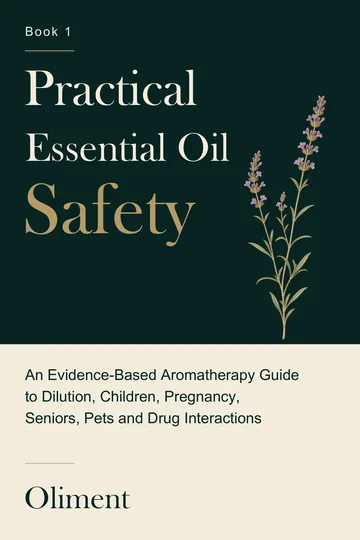
Practical Essential Oil Safety brings together in 184 pages what this guide summarizes: 15 chapters with the reason behind every rule and 7 appendices to check whenever you are about to use an oil.
As an Amazon Associate we earn from qualifying purchases.